Exhibits
Attempted Bank Raid
1876 was a year of great change in America’s history. America celebrated its 100 birthday with the Centennial exposition in Philadelphia. Custer was also killed at the Battle of Little Big Horn and Rutherford B. Hayes beat out Samuel Tilden for the Presidency. Tilden won the popular vote but Hayes won the Electoral vote and became the 19th President of the United States.
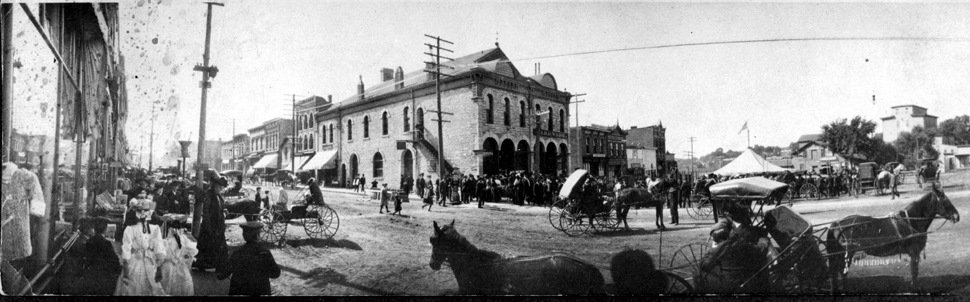
Northfield in 1876 was a growing Southern Minnesota community. By this time, the town had two colleges and saw the completion of a railroad through town. The town also had many prominent business leaders and a strong bank. It was the bank that would draw the attention of America's most notorious bank and train robbers, the James-Younger Gang.
In late August, 1876, the James-Younger Gang, consisting of Jesse and Frank James, Bob, Jim and Cole Younger, Clell Miller, and Charlie Pitts, and Bill Stiles, head for Minnesota. After arriving in Minnesota, the gang divided into scouting parties of two, three and four men. Looking for possible sites to execute their plans, they considered banks in Minneapolis, Red Wing, St. Peter, and St. Paul, as well as Madelia, Mankato, Lake Crystal, St. James, Garden City, and Northfield.
On September 4th the gang rode into Mankato to rob the 1st National Bank of Mankato (the gang’s first choice). However, the gang decided to abort the robbery and head for their second choice, Northfield. Little did the gang know that this decision would end all of their careers of outlaws and result in three of the gang members being killed and two townspeople also being killed.
The Early Years of Northfield
John W. North came to the area that would become Northfield in 1855. He bought land from three farmers, Daniel Kuykendahl, Daniel Turner, and Herman Jenkins. North chose the Cannon River valley because of the potential hydraulic power and its abundant natural resources. He ruled out Faribault because of the presence of liquor.
North immediately started work on a mill and bridge. North ignored the natural curvature of the Cannon River and platted the town in 95 rigid grid blocks. North's wife, Ann Loomis North, came in 1856 with their young daughter and had an immediate impact on the town. Ann was a great promoter of the town and also helped John found many of the early societies in Northfield.
North sticking to his values, North started work immediately on a Lyceum Society which was built in 1856. North also platted a section of the town to be devoted to education and in 1856 the first public school was opened.
North's time in Northfield would only last a few short years. Because of the Panic of 1857, North was financially crippled and in 1859 he sold all of his assets in town to his friend from Syracuse, Charles A. Wheaton.
North and his family left Northfield in 1861. North became Surveyor General of Nevada. After spending time in Nevada, North headed to Knoxville, Tennessee and after a short stay there North moved to California where he founded two towns and lived out the rest of his life.
By the time the Norths left, Northfield was a thriving community with a public school, five churches, 80 houses, and a main street full of businesses.
Following North's, values in 1866 Northfield College was founded. This college would later become Carleton College named after William Carleton who donated $50,000, which at the time was the largest donation ever made to a western college.
Again following the values laid out by John North, in 1874 St. Olaf School was founded. The school originally was located in the two old public school buildings across from where Carleton College is located. St. Olaf officially became a college in 1889.